For financial advisors who are almost (but not quite) satisfied with their own practice, and can't figure out what's missing.
Plan your client communication for the whole year, and stay in control of your time.
Saywell maps a year of touchpoints for every household on your book, tier by tier, so you know who to contact, when and why. Every Monday morning, you're reminded who to contact that week.
When you're ready, Saywell drafts each message for you to review, adjust and send.

Win back your capacity to take on more clients, or simply take more time off.
30 beta places. Beta opens December 10, 2026.
See Saywell in action
A week in the practice of Michael, a financial advisor with 142 households.
Every client taken care of. Every message sounds like you. You send each one.
Illustration with made-up clients.
A week with Saywell, scene by scene
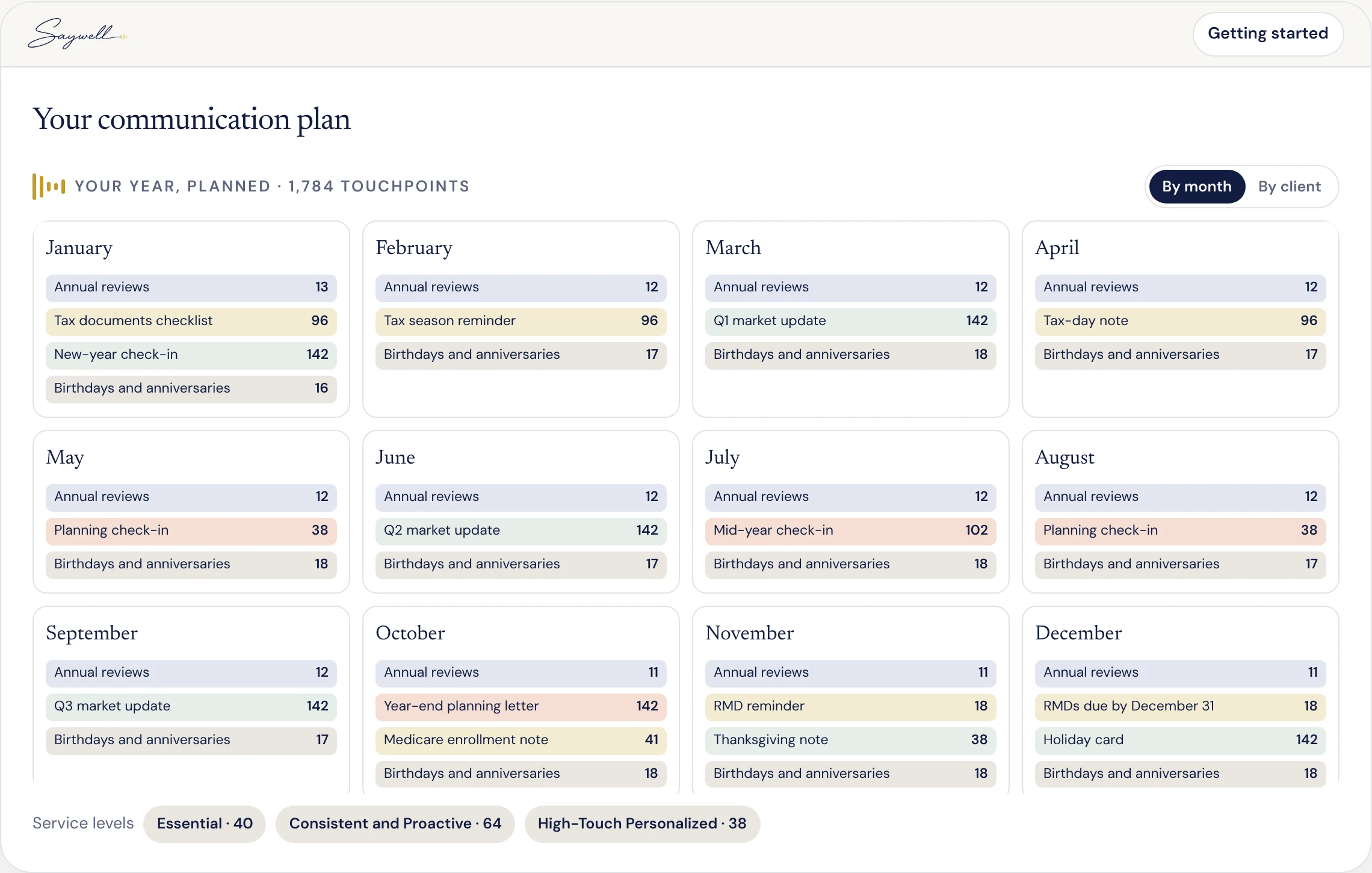
Getting started: Michael uploads the client list he already has. Saywell finds 142 households and plans his whole year, month by month, with a service level for each client: an annual review for every household, tax documents in January, a market update every quarter, mid-year and planning check-ins, the year-end planning letter in October, RMD reminders in November and December, a holiday card, and every birthday and anniversary. The plan can also be seen client by client.
Monday, 7:00 AM: Saywell's email lists his week: Helen Roth's birthday on Wednesday, a follow-up for Robert and Linda Hayes, David Chen's review in two weeks, and tax documents to collect from Priya Natarajan.
Monday, 9:30 AM: Michael presses Draft it next to the Hayes follow-up and pastes the transcript of Thursday's annual review. Saywell reads all 52 minutes and finds two decisions, one form to sign and one date. It drafts the follow-up to Robert and Linda: Robert's required distribution goes out in early December, $25,000 moves from Linda's IRA to her Roth IRA before December 31, Linda signs the conversion form by December 12, and their updated plan is attached. It leaves out the tax bracket detail, because Robert prefers the bottom line, and adds a January check-in to their plan.
Tuesday, 9:12 PM: Robert Hayes emails: "Saw the market's down again. Should we be worried?" Michael forwards it to his Saywell address. He asks Saywell to help him reply and chooses to talk it through.
Saywell asks what Robert most needs to hear, and whether he wanted numbers or a conversation in past market drops. Michael answers: the two years of income set aside in March, and a conversation. Saywell reflects his plan back, and Michael offers Thursday at 2 or Friday at 10 for a call.
Michael presses Draft it, and Saywell writes the reply the way Michael writes, leading with the two years of income set aside, and checks the facts, the tone, what was left out and how Robert might read it. Michael presses Edit and adds a line of his own: "Linda is very welcome to join us." Then he opens it in his own email and sends it.
Wednesday: Michael presses Draft it next to Helen Roth's birthday, and Saywell drafts her note, remembering her trip to Lisbon with her sister in May. The Hayes follow-up went out on Monday. He presses Draft it for Priya Natarajan's tax documents, and that is drafted too. David Chen's review can wait until next week.
Thursday: Helen replies, "Thank you, Michael! The long lunch is booked, and Lisbon can't come soon enough. I'll send you a postcard."
You know which clients you've been meaning to check in with.
The notes just never quite get sent.
It isn't that you don't care. It's capacity. Reviews, tax season, RMDs, year-end planning. And in between, 150 households who each deserve a personal touchpoint from you.
“I know what I want to say. I just don’t know how to write it.”
Improve the economics of personalized service.
Personal touchpoints are what clients value most. They're also what cost you most.
Your financial planning, analysis and investment work form the foundation of your advice. But clients also need to understand your recommendations, feel confident in their decisions, know what to do next and feel well looked after.
Much of that happens through communication.
Sometimes it's a meeting or phone call. Often, it's an email or text. Communication supports the advice you deliver and shapes how clients experience your service, especially between meetings.
Across an entire book, knowing who to contact, when, about what and how best to approach each client takes considerable time and attention.
Maintaining that standard traditionally means working longer hours, hiring additional support staff or limiting the number of households you serve.
Seen together, it's a body of work in its own right. And like any body of work, it can be planned.
Saywell helps change that equation.
It plans your client communication and drafts your emails and texts to sound like you, with the right approach for each client and the purpose of each message.
Deliver more of the personal service you've always wanted to provide, without doing all the organizing and preparation yourself.
Make room to grow your practice or enjoy more time away from work.
With Saywell, you'll know:
- Who to contact this week, and why, without keeping a list in your head.
- How to turn every birthday, annual review and RMD deadline into a message drafted at a click, not just another reminder in your CRM.
- How to reply to a worried client after a market drop in minutes, with an email that sounds like you and says what that client needs to hear right then.
- How to reply when a client writes, “I asked ChatGPT, and it said…”
- How to share news with your whole book, like a change on your team, in one message that sounds like you, opened with each household's names.
- How to tell each client about a fee increase in a message written for them, in the way that client takes in news best.
- How to finally write the email you've been putting off, by talking it through with Saywell first.
- Never to send another “just checking in” email. Every check-in has a real reason: a review, a deadline, a birthday, something happening in their life.
How Saywell works
A communication system for financial advisors.
Saywell helps plan your client communication throughout the year, then drafts emails and texts that sound like you, at the level of service you've chosen for each client.
When a message is due, you open it and Saywell drafts it, with the right tone for that client and that situation.
Saywell helps with three kinds of message:
- The everyday ones: replies, check-ins, thank-yous and meeting follow-ups.
- The proactive ones you always mean to send but rarely have time for.
- The difficult ones: bad news, a worried client. The ones you second-guess and rewrite several times before you hit send.
Your judgment. Your relationships. Less effort preparing the communication that supports them.
Some clients want every number. Some want the bottom line. Some want to hear it from you.
You wouldn't approach every client conversation in exactly the same way. For example:
- Margaret Ellis likes to hear it personally.
- David Chen prefers a direct explanation and clear next steps.
- Thomas Reyes wants the numbers and the reasoning behind them.
You know the difference, and it shapes how you communicate. Saywell brings that understanding to your written messages. It considers your writing style, each client's preferences and circumstances, and what you want the message to achieve.
Saywell doesn't write form emails.
A form email
One message for everyone, with a name swapped in. Clients recognize it the moment they open it.
An email from Saywell
Written for one client. It sounds like you, and it's shaped by what you know about them and what you want the message to achieve.
When the same news has to reach every client, like a fee change, the notice itself can be identical. What changes is the note you put on top of it. Saywell drafts that note for each client, so it sounds like you and suits how that client takes in news.
Example: a fee increase. Same fee notice. Three different clients. Read them. You'll know which client each one is for.
The fee notice · the same for every client
Notice of change to your annual advisory fee
From your next billing cycle, your annual advisory fee will change from $4,800 to $5,600. This is the first change to your fee in four years. The services in your advisory agreement are otherwise unchanged.
Illustration with made-up clients.
Saywell is built on 20 years of communication expertise: how different people prefer to receive and process information, and how to communicate well with each of them.
Saywell pays for itself in your time. The bigger return is in your clients.
Saywell is $179 a month, or $1,790 paid annually.
Your time
54 min
If an hour of your time is worth $200, Saywell pays for itself when it saves you about 54 minutes a month. On the annual plan, it's about 45 minutes.
Your clients
1 client
Keep one client who might have quietly drifted away, earn one introduction, or win one new household. Take a household like Margaret's:
- Added to your practice's revenue
- $5,600 a year
- Added to your book's value if you sell
- about $18,000
Book value based on the 2025 average of 3.27 times recurring revenue for advisor books of business (Succession Resource Group, February 2026).
Illustrations only. Actual results depend on your practice and how you use Saywell.
Personal service. Professional control.
Your clients trust you with important financial decisions and deeply personal information. Saywell is built to support your professional judgment and the relationships you've worked hard to build.
You decide:
- The service level each client receives
- Which clients to contact, and how often
- What goes in each message
- Whether and when to send it
Saywell prepares. You send. You review every message for accuracy, your fiduciary duty and your firm's rules. Nothing is sent automatically.
Built for advisors. Private by design.
Saywell is built for people who carry confidentiality obligations, and designed around the standard their clients trust them to keep.
Your data belongs to you, and it's stored in the United States. Your emails are used only to write for you and are never used to train AI models. Saywell encrypts your data in transit and at rest, we never sell your data, and you can delete it at any time. Full details are in our Privacy Policy.
The Saywell beta is for:
The first group is limited to 30 advisors. Beta opens Thursday, December 10, and stays open until February 18, 2027, or until all 30 places are taken.
- Financial advisors in the United States
- With an established client book
- Independent or at a larger firm
Frequently asked questions
Will Saywell really save me time, or will it become another system to manage?
It takes work off your plate rather than adding to it. Upload your client list once and choose the level of service each client receives. Saywell maps out who to reach out to, and when, all year, and tells you each Monday what's coming up. When you're ready, it drafts each message with the right tone for that client and that situation. You read it, adjust it if you want, and send it.
Do I have to upload my client list to try it?
No. Write one message for one client first, then a handful, then the rest.
I already have a CRM and support staff. Where does Saywell fit?
Your CRM supports your records and workflows. Your team supports client service and administration. Saywell focuses on the communication that supports your service standards: planning relevant contact and preparing individual emails and texts. It works alongside the systems and people you already rely on.
Does every client have to receive the same level of service?
No. Choose Level 1 Essential, Level 2 Consistent and Proactive, or Level 3 High-Touch Personalized Service for each client. You can then adjust any client's plan to suit them, as their needs and circumstances change.
Does Saywell automatically know when I've had a meeting or phone call?
No. Saywell doesn't connect to your calendar, so you tell it. Forward your meeting notes or transcript, or add a quick note. Saywell doesn't just summarize the meeting. It writes the follow-up for how that client prefers to take in information, leading with what matters most to them, in words that sound like you. Then it plans what comes next.
How does Saywell learn how I write?
You share a few emails you've written, and Saywell learns your voice from them. It keeps learning from every edit you make. It also learns about each client, from what you tell it and from the emails you forward from them. So with every draft, it sounds more like you and fits more closely how that client likes to hear from you.
Will my clients know I used Saywell?
Not unless you tell them. They'll receive an email from you, sent from your own email account, that sounds like you and says what you decided to say. Saywell prepares the draft. You read it, adjust it if you want, and send it, so every message is yours.
Will Saywell meet my firm's privacy, security and compliance requirements?
Saywell drafts messages for you to review. It doesn't make financial advice decisions or send client communications automatically. You remain responsible for checking factual accuracy, your fiduciary duty and your firm's rules. Your firm can review our Privacy Policy, Data Processing Addendum and list of subprocessors to assess whether Saywell meets its policies and obligations.
Can I start with a few clients?
Yes. You can start with a manageable number of relationships, try the client communication plan and see how Saywell drafts messages, then expand to your whole client book.
What happens after I sign up for the beta?
Elize Hattin, Saywell’s founder, emails you within 24 hours with your invitation to setup day on Thursday, December 10. Can’t make it on the day? You’ll get the recording of the welcome and setup session. The beta stays open until February 18, 2027, or until all 30 places are taken. Your first month is $10 from the day you set up, then $179 a month.
Give your clients more of the attention they value.
Deliver the standard of client service you've always wanted to be known for, without personally organizing and preparing every client message. You read, adjust and send every message.
Beta opens Thursday, December 10, 2026, and stays open until February 18, 2027, or until all 30 places are taken.
Thank you. One last step.
Your details are saved. Go to payment